
WHY AI CAN'T PLAN YOUR SAFARI
We put the final mockers on being replaced by an algorithm
Artificial intelligence is genuinely extraordinary and we're not afraid to say so. It can write code, create images, compose symphonies, diagnose diseases, translate languages in real time and hold a conversation about almost anything with a fluency that would have seemed like science fiction 10 years ago. It's a huge technical achievement and if we weren't so over it, we'd give it a standing ovation. Yes, over it and there's a significant reason why, because believe it or not, in spite of its cleverness and imitation of human intellect, AI cannot plan a safari. Here's why:
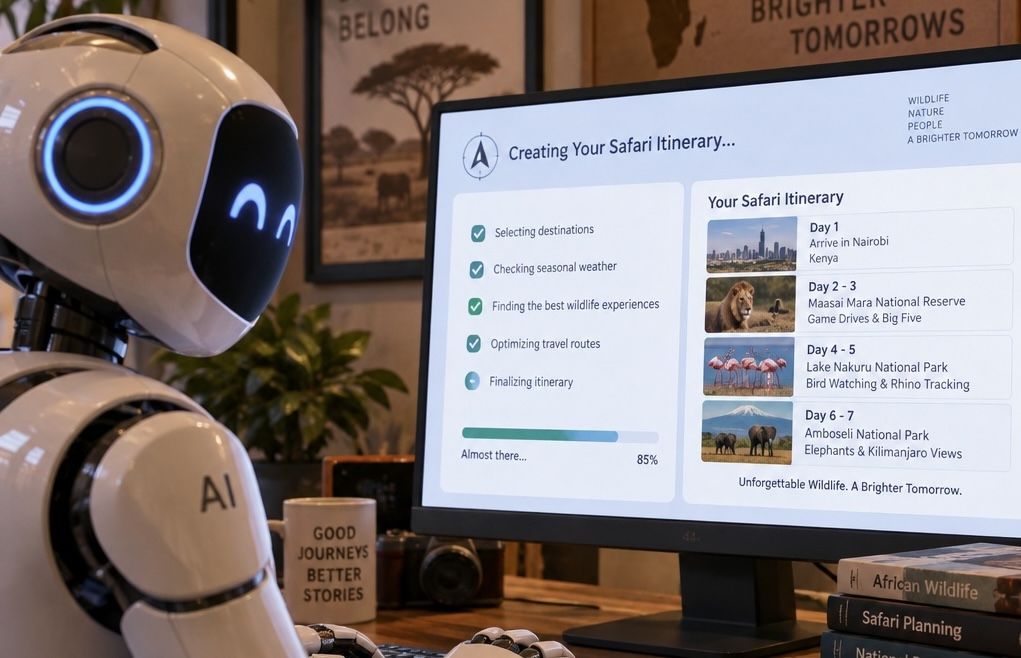






The most important reason why the likes of ChatGPT, Claude, Perplexity and Gemini can't do what we humble humans can do is actually very simple, first of all, they're not real and second of all, they've never been to Africa. They've just ingested everything ever written about it on the internet, good and bad, prosaic and meaningful or cheap and crass.
That's right, AI (or large language models as they're also known) knows about Africa the way a very well-read person who has never left their house knows about Africa: comprehensively, accurately and entirely without the thing that actually matters, which is the experience of what it's like to be in Africa.
AI knows the names of the lodges, the wildlife lists, the average rainfall in the Okavango in March and the distance between Livingstone and the Lower Zambezi by road. What it doesn't know is what it feels like to walk into Toka Leya at sunset with the Zambezi rushing past below the deck on its way to the Victoria Falls. It doesn't know which properties have quietly slipped in the past two years and which ones have quietly become extraordinary. It doesn't know the best combination of destinations when designing a 14-night itinerary and the logistics required to effortlessly move between each of them. All of which is a deal breaker because in safari planning these things are everything.
It also won't be there when things go awry, which they can do sometimes. Being stuck at an airport in a strange country with a cancelled or delayed flight that impacts the rest of your safari itinerary isn't something that your friendly neighbourhood Chat bot can fix in a hurry. But guess what, humans can and do fix all sorts of oopsies like this.
Ask AI to plan a safari and it will ask you a series of questions. Budget, dates, interests, experience level, preferred destinations. It will take your answers and produce an itinerary that fits them technically, the way a suit off the rack fits someone who hasn't been measured. It will be competent and it will be entirely generic and it will have no idea that what you actually need, having just come through a difficult two years and desperately needing to feel something genuine and wild and completely removed from your ordinary life, is four nights alone at San Camp in the Makgadikgadi Pans with a guide who understands silence.
That's something that's only learned in a conversation between two humans, one of whom has been listening carefully enough to hear what you didn't quite say.
Safari planning is full of judgment calls that have no objectively correct answer. Is this family ready for a walking safari? Should these clients spend their budget on one exceptional lodge or spread it across three good ones? Is the Masai Mara worth it this year given the increasing vehicle congestion at certain times, or would the Serengeti's southern circuit serve them better? Is this particular couple, who says they want adventure, actually going to be happier somewhere with a very good spa and a sunrise game drive they can take or leave?
None of these are questions with algorithmic answers. They're questions that require knowing the destination, knowing the product and knowing people well enough to make a call that you're prepared to stand behind personally.
We make those calls every day and we've been making them for decades. And when we get them right, which we do rather consistently because our clients keep coming back, it's not because we ran the numbers, it's because we've been on enough game drives in enough places with enough different kinds of people to know, in our bones, what works and why.
The safari industry runs on relationships in a way that almost no other travel sector does. These relationships are built over years of showing up, of sending the right people, of being honest when something isn't right and enthusiastic when it is. AI has no relationships, just access to online booking platforms. The difference, for a client who ends up with the room they actually wanted rather than the one that happened to be available, is considerable.
In the spirit of fairness, and because we're actually nice people who prefer honesty to a sales pitch, AI is genuinely useful for certain things in the travel planning process. It's excellent at aggregating information quickly, at answering factual questions about visa requirements and vaccination recommendations and flight connections, at producing packing lists and generating itinerary templates that a human then makes worth having. It is a research tool of considerable power and we'd be silly to pretend otherwise.
But research is not expertise. A packing list is not a safari. And an itinerary template produced by something that has never sat around a campfire in the Luangwa Valley at midnight, listening to a lion work its way along the river bank, is not the same as one produced by someone who has and who knows, from that experience, exactly why you need to be there.
Every safari produces something that couldn't have been planned, predicted or put in any itinerary regardless of who or what produced it. It's the thing you weren't expecting and will spend the rest of your life being grateful for. Getting you to the place where that's most likely to happen, with the right guide and the right conditions and the right amount of time, requires the kind of accumulated, specific, personal knowledge that only comes from doing this for a very long time and caring deeply about getting it right.
That's what we do with no algorithm required.
Text: Sharon Gilbert-Rivett